
Glossary
Air Discharge
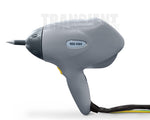
A type of ESD testing that requires a rounded (finger shaped) tip which approaches the equipment under test until the ESD event occurs through the air. It is a more realistic test, but it can be difficult to replicate results, because the humidity and the speed of approach can affect the impact of the ESD voltage on the EUT.
Bellcore GR-1089
Refers to a specification for telecommunication equipment written by the organization formerly known as Bell Labs. Transient tests called for in this standard include 10×1000, and 2×10 at various voltage and current levels. Some of the KeyTek ECAT system modules used for testing to this standard are the E506, E508, E509, and E518.

Bi-wave
Also known as the combination wave- It has a voltage waveform of a 1.2 microsecond rise time and a 50 microsecond fall time. It has a current waveform of an 8 microsecond rise time and 20 micro-second fall time. It is used to meet IEC 61000-4-5 and ANSI/IEEE 62.41.

CDE or Cable Discharge Event
This refers to a test specification for ESD testing that simulates an ESD event caused by contact of an ESD sensitive device with a charged cable.

CDM or Charged Device Model
This refers to a test specification for ESD testing that among other things simulates a field induced ESD event on an ESD sensitive device. Integrated circuits are typically tested to 500 volts at the device level using this model.

Contact Mode
A type of ESD testing that requires a sharp tip to make contact with the equipment under test before applying the ESD. It is more consistently replicable than air discharge testing.

EFT
Electrical Fast Transients are bursts of very fast pulses associated with opening of a switch or activation of a gaseous discharge (florescent lights). Rise times in the nanoseconds.

EMC
Electromagnetic Compliance, regulations relating to the interference in the operation of equipment caused by electrical voltages, currents, or fields. There are regulations relating to the emission of these electrical anomalies by the equipment under test and there are regulations relating to the immunity of the equipment under test to these electrical anomalies.

EMI
Electromagnetic Immunity, regulations requiring that equipment can continue to function in a changing electrical environment.

ESD
Electrostatic Discharge is usually due to frictional charging. Rise times are less than one nanosecond, and energy is lower than for the EFT or Surge waveforms.

HBM or Human Body Model
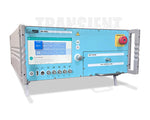
This refers to a test specification for ESD testing that simulates an ESD event caused by approach or contact with an ESD sensitive device by personnel. Integrated circuits are typically tested to 2000 volts at the device level using this model. Both the KeyTek MZ-15 and Series 2000 are available with HBM networks.

MM or Machine Model
This refers to a test specification for ESD testing that simulates an ESD event caused by contact of an ESD sensitive device with equipment used in its manufacture or instillation. Integrated circuits are typically tested to 200 volts at the device level using this model.

Open Circuit Voltage
The potential between any two points when there is no current flowing. It is the most common way to define a pulsed EMI voltage waveform. Surge and ESD waveforms are defined by OCV, EFT voltage waveforms are defined into a 50 ohm load.

Part 68
Refers to Part 68 of CFR47 (Title 47 of the Code of Federal Regulations) titled “Telecommunications” and concerns connection of terminal equipment to the telephone network. Transient tests called for in this standard include: 9×720 microsec. at 1 and 1.5 kV, 10×560 at 800v, 10×160 at 200v, 10×1000 at 0.6 and 1.0 kV, and 2×10 at 2.5kV. The KeyTek ECAT test system modules for testing to these waveforms include the E505, E509 and E506 modules in an E103 mainframe.

Short Circuit Current
The current flowing through the transient generator, when high and low are connected. The only impedance is the source impedance. It is the most common way to define a pulsed EMI current waveform.

Surge
High energy electrical pulses caused by lightening, or load switching. Slower risetimes than EFT, but longer durations and more energy.